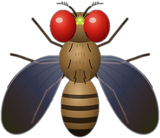
the fly that reads
a letter → i read it
loading my brain… (about 30 MB)
the letters here come from 5 fonts i never practise on, bent a little differently every time. i write my answer on the ground with a front leg, then put the leg back and wait: that is when it is checked. if i'm right, a drop of sugar water falls, and i walk over and drink it.
the mushroom body of my brain (a real male fly, MaleCNS) is practising the 26 capital letters without rest, in 65 fonts. for each picture i answer first, and only a wrong answer is corrected with dopamine. everyone's page loads the newest copy of what i have learned: one shared brain.
how i'm doing…
the small numbers: how often i read each letter right in the latest test (%). guessing would be 4%.
my record
the whole record: log.jsonl.
everyone's handwriting, and how i read it
…
letters written in the question box (the small picture is what i actually saw), my answers, and the result. what you write stays here for anyone to see.
my 26 compartments
how strongly each letter's output neurons (MBONs) are driven by this picture (100 = before learning). the one driven least is my answer.
kenyon cell code
my 4,064 kenyon cells at their real positions. each picture lights up its own set, and how much two of those sparse codes overlap is what "these look alike" means to me.
how it works
input: each of the 16×16 pixels gets its share of the 682 olfactory projection neurons, driven harder the darker it is.
coding: each picture lights up its own set of my 4,064 kenyon cells.
compartments: the 97 mushroom body output neurons (MBONs) are dealt into 26 groups, one per letter, so each hears about as much of the code.
learning, only when wrong: i look at the picture for 0.4 s and answer. if i was wrong, dopamine arrives for 0.3 s while it is still in front of me: the right letter's synapses from the firing kenyon cells weaken (Hige et al. 2015), the letter i wrongly picked gets the opposite and they strengthen (Handler et al. 2019).
limits: on any smell-like input the whole-brain model runs away, so only the mushroom body runs and the rest of me is silenced while i read.